
Who Has Your Back?
Social trust vs asabiya

I’m glad that philosophers are growing familiar with social trust. As a field, we have moved beyond understanding predatory behavior merely in terms of psychopathology, trauma from poverty, or “just being an asshole.” I can usually mention "social trust” in conversation with philosophers and they’d understand roughly what I’m talking about. This was not the case, say, in the mid-2010s, when social trust was something that, for the most part, only immigration restrictionist philosophers were familiar with, it being something of a “hate fact” at the time that the migrants flooding into Europe were from the lowest-trust places in the world. Be that as it may, it now seems to me that some of the best expositors of social trust are philosophers, such as David Miller and Kevin Vallier.
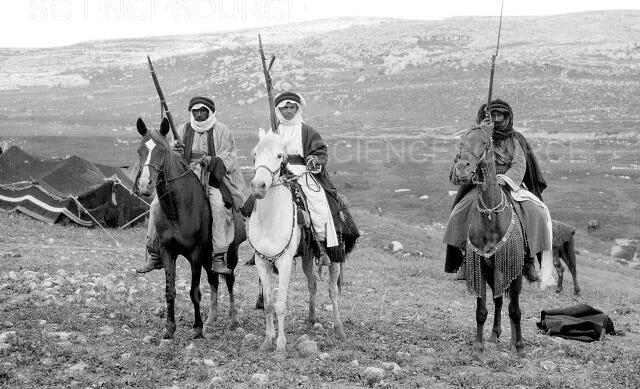
Although I am certainly no expert on social trust, I am confident that there’s a big gap in our understanding of it, and that’s because we’re not very good at understanding its connection to a nearby, but distinct, phenomenon. So in this post I am begging social scientists and philosophers to distinguish between social trust on the one hand and social cohesion on the other. Or better than “social cohesion,” what the 14th century historian Ibn Khaldun called “asabiya,” a construct popularized by Peter Turchin, which means something like “collective willingness to stick with, and stick up for, your community.”
Social trust
Essentially, a society has high levels of social trust if most people in that society expect the strangers there to adhere to cooperative norms. Francis Fukuyama describes trust as “the expectation that arises within a community of regular, honest, and cooperative behavior, based on commonly shared norms, on the part of other members of that community” (1995: 26). Kevin Vallier seems to understand social trust as a belief held by most community members that others are generally necessary or helpful for achieving diverse goals and that they are willing and able to follow moral rules, primarily for moral reasons rather than mere self-interest (2021: 24-25).
You can get a feel for social trust by looking at ways social scientists test for it. The most common way is asking them how they feel about trusting strangers, particularly via asking people how much they think that “most people can be trusted,” as opposed to “you can’t be too careful in dealing with people.” One of the most interesting field studies of social trust involved leaving wallets out with money, and seeing how many people in various countries returned them (with or without money inside).
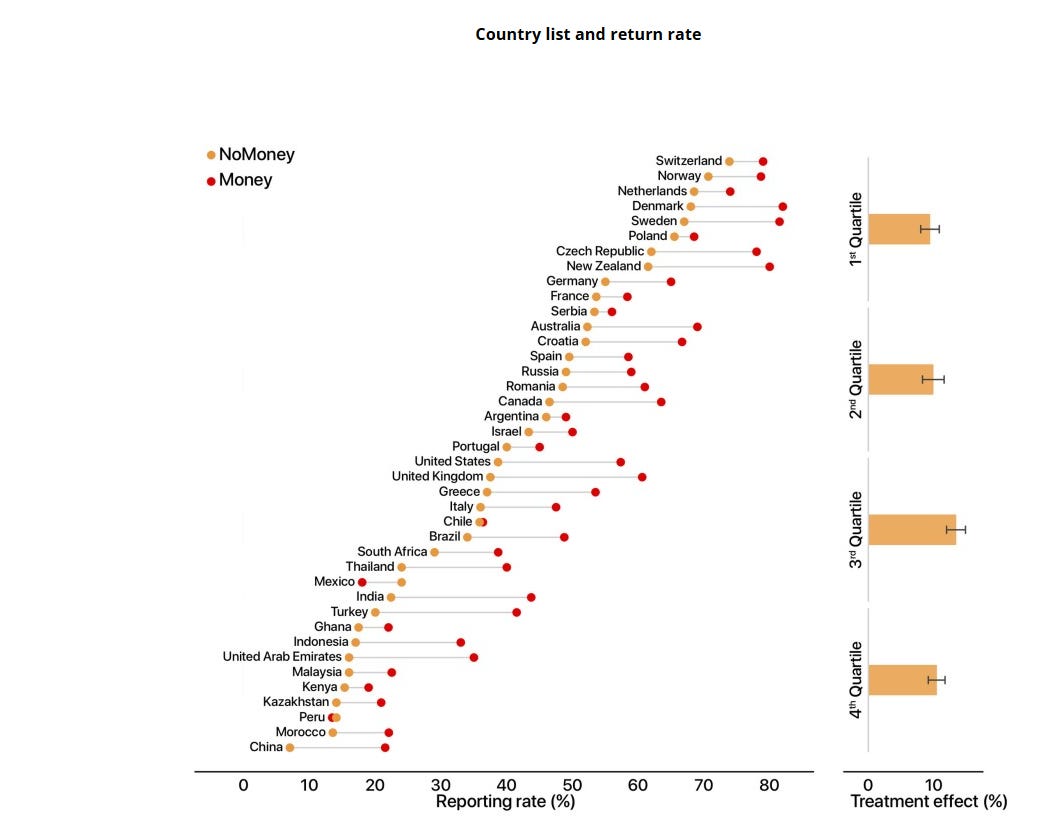
Trusting societies have some significant advantages, prominently among these being safer and richer. They have better institutions, better social programs, and a more equal distribution of wealth. People live longer and are more innovative. You can turn your back on people when you socially trust them. But does this mean they’ll have your back?
Asabiya
Peter Turchin did us all a great favor by reintroducing Ibn Khaldun’s construct of asabiya (apparently a neologism of Khaldun’s) to the social sciences and reading public. When Turchin is defining asabiya narrowly, it seems to have primarily to do with martial sacrifice on behalf of the group.
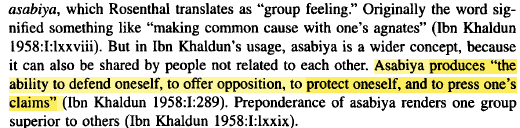
Turchin, Historical Dynamics (2003), p. 43
Sometimes Turchin gets a bit squishy on asabiya, and lets social trust bleed into its territory. For instance, he may expand it to a “capacity for collective action.”
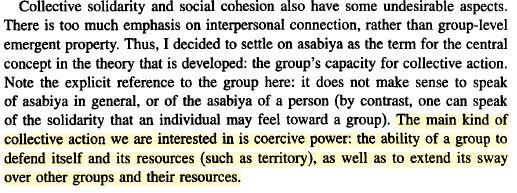
Turchin, Historical Dynamics (2003), 45
But the kernel of the idea is conflict-oriented.
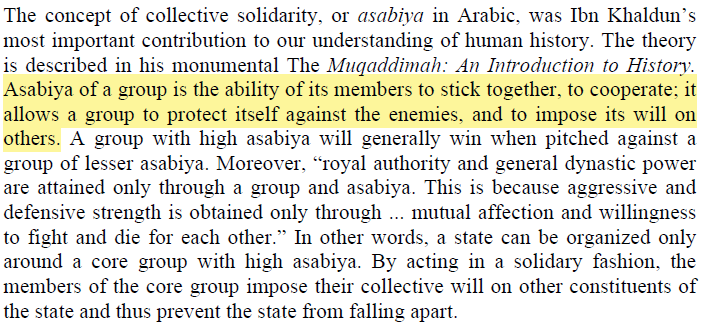
Turchin, War Peace War (2005), p. 78
Functionally, asabiya for Khaldun is that group consciousness, cohesion, shared purpose, and group resolve that allows tribes to conquer soft and enervated civilizations that have been enfeebled by luxury. It’s almost like “group competitive agency.”
Is social trust sufficient for asabiya?
So a lesson one gleans from Turchin’s writings is that asabiya, not mere social trust, is necessary for collective will and a group’s capacity for decisive action, particularly in the face of inter-group competition and existential threats. What’s interesting is that it’s possible for a society to have ideal levels of social trust and yet lack asabiya. If you live in a neighborhood (I won’t say “community” or even “society”) of diverse professionals, many of whom are immigrants, you know quite well that it’s completely possible to live among people who would never assault, burglarize, or even cheat you, but nonetheless wouldn’t risk themselves to rescue you if you were attacked on the street, or jump into your burning house to save your kids. A country (I won’t say “nation”) that is composed of such people would probably be peaceful and prosperous—at least until attacked. But upon being attacked, its various groups would break apart and flee for safer shores. They’re like greased gears that work well together, but in a machine that’s easily smashed and they, being first and foremost gears, are as happy to work in a new machine as they were the old one.
Even appeals to “social cohesion” aren’t enough to capture what we need to be worried about here. Social cohesion does speak to the need for a “glue” that holds a society together. I value social cohesion deeply, and social cohesion will get people risking their lives to save yours from accidents and burning buildings. But social cohesion alone doesn’t capture that thumotic element that a group must have not only to stick together, but also to protect itself from insult and injury. A pacifist religious community may have high social cohesion (as well as social trust, for that matter), but yet, due to their religious commitments, be unable to resist insult and injury to its members. These groups, such as the Amish, find protection inside the countries of more martial nations or are quickly exterminated.
Is social trust necessary for asabiya?
Here is Gallup’s survey of people from 45 countries on their willingness to fight in a war “that involved” their countries.
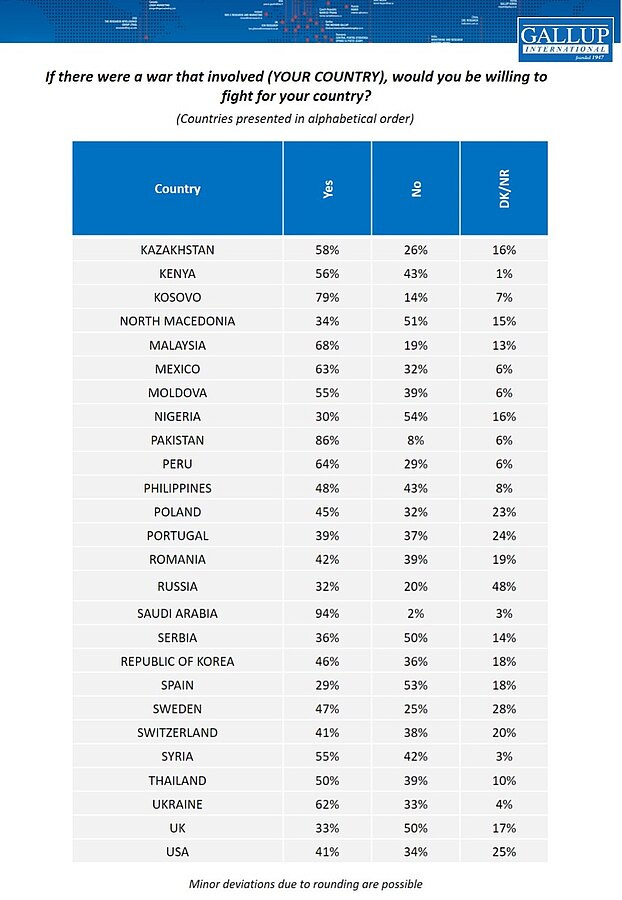
Yes, people say one thing and do another. And yes, I get that there are many confounds here. One difficulty is that a Pakistani is likely to interpret Pakistan being “involved” in a war as Pakistan being attacked, while an American is likely to interpret America being “involved in a war” as America attacking some faraway country. Be that as it may, it’s still true that countries with a high percentage responding positively are low-trust societies: Saudi Arabia, Armenia, Azerbaijan, Pakistan.
You also see, in some black neighborhoods in the US or Muslim enclaves in Europe, a willingness to fight together against a “foreign” element (cops, for instance), even though these same neighborhoods are notoriously low-trust. I can’t imagine my high-trust neighbors resisting people with guns trying to take me down, but this happens regularly in such “communities” when police are trying to apprehend someone. I’m not talking about gang members here, but just people from the neighborhood.
I think we all know pugnacious families who bicker among themselves but seem to galvanize whenever they feel one of their members is attacked. Whatever you think about the morality of doing so in this-or-that case, this trait is certainly something we should want our conationals to have.
Tradeoffs
Obviously it is possible for a polity to have high social trust and strong asabiya. For instance, Victorian England probably had high social trust, but it also had extraordinary asabiya (look up the British Expedition to Abyssinia). Nonetheless, since social trust and asabiya are two different traits and do not, apparently, correlate particularly strongly, the question of tradeoffs arises . Would you rather be part of a nation that has, say, 10:10 on social trust, but 5:10 on asabiya, or the inverse? How much crime, corruption, and dysfunction would you accept for how much gain in asabiya?
One rationale advises trustmaxxing. The idea is that the extra wealth, technology, and state capacity resulting from a high-trust society would compensate for significant deficiencies in asabiya. Sure, maybe your people aren’t particularly willing to take great risks or bear serious costs to defend your community, but then again they wouldn’t need to when they can zap threats via drones.
A lot depends on the details here, but I think this is a mistake.
One reason is that a nation’s opponents may also be high-trust and thus our technological and industrial match. WWI Germany was no lower-trust than France, England, or the US. All other things being equal in such a matchup, my money will be with the side that has more asabiya.
A second reason is that the war on terror seems to demonstrate that high-asabiya peoples, such as the Taliban, are highly resilient against more technologically advanced and better-supplied opponents. Relatedly, there might be something about high-trust societies that make them worse at long wars that drag on for years or decades. High-trust societies try to be principled and fair-minded. As a conflict wears on, debate around the war driven by these principles will eventually undermine morale and fighting resolve domestically.